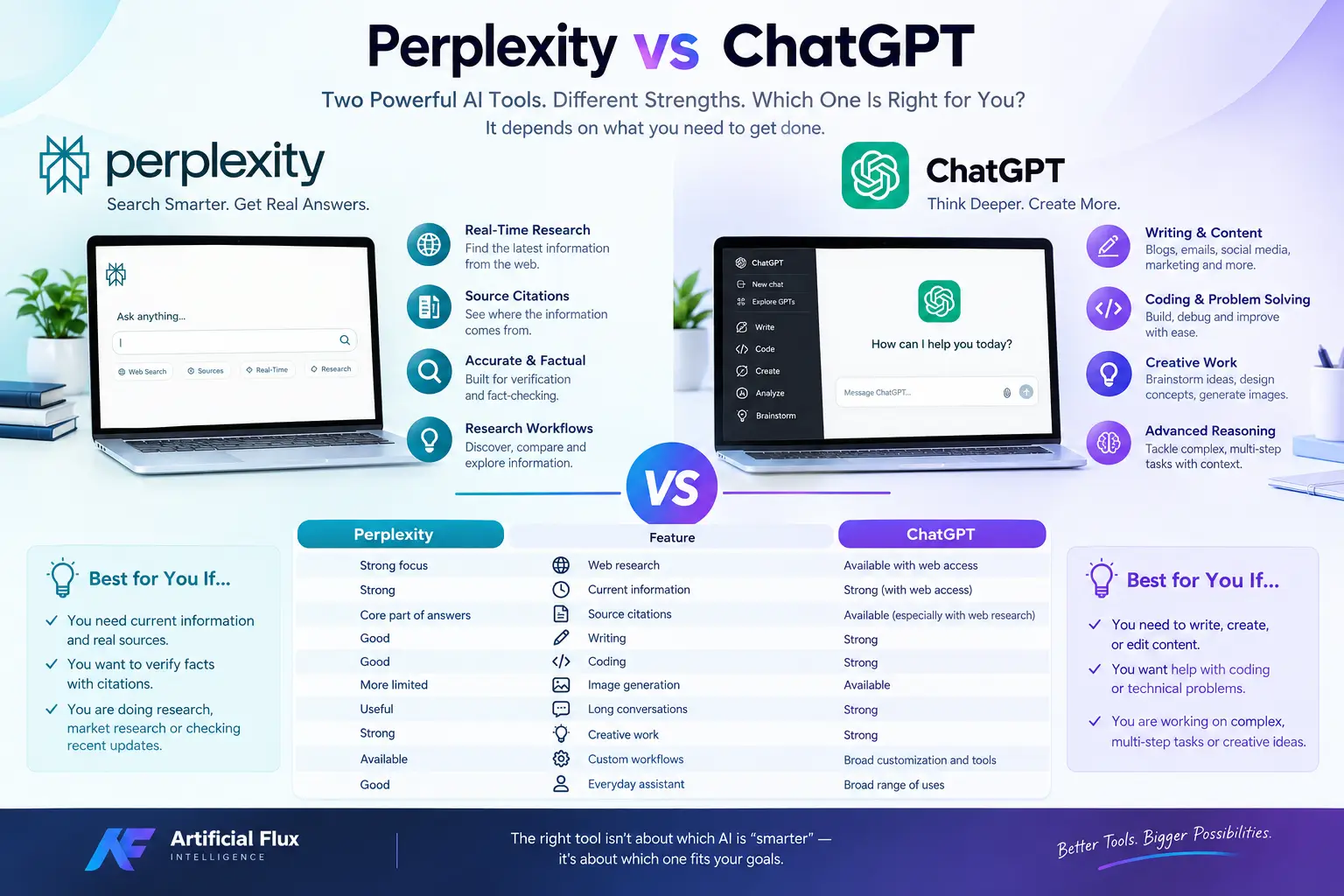
Perplexity and ChatGPT are both powerful AI tools, but they are built around different strengths. Perplexity is often more useful for current research and finding sources, while ChatGPT is stronger for writing, coding, creative work, and longer tasks. The better choice depends on what you need to get done, and Artificial Flux Intelligence can help you choose the right AI tools for your workflow.
If you are new to ChatGPT, our article on what is ChatGPT explains how the AI assistant works and what you can use it for. You can also explore our Gemini article for a closer look at its search-focused approach.
Perplexity vs ChatGPT: What Is the Difference?
The biggest difference is how the two platforms approach information.
Perplexity is designed around AI-powered search. It searches online sources, combines information from those sources, and presents an answer with citations. This makes it useful when the information may have changed recently.
ChatGPT is designed as a broader AI assistant. It can answer questions, write content, analyze information, help with coding, work with files, brainstorm ideas, and support many other tasks. Depending on the version and settings being used, it can also access current web information.This means the comparison is not simply about which AI is “smarter.” It is more useful to ask which tool fits the job you are doing.
Perplexity vs ChatGPT at a Glance
| Feature | Perplexity | ChatGPT |
| Web research | Strong focus | Available with web access |
| Current information | Strong | Strong when web access is used |
| Source citations | Core part of answers | Available, especially with web research |
| Writing | Good | Strong |
| Coding | Good | Strong |
| Creative work | More limited | Strong |
| Image generation | More limited | Available |
| Long conversations | Useful | Strong |
| Research | Strong | Strong |
| Fact-checking | Strong workflow | Strong with source verification |
| Custom workflows | Available | Broad customization and tools |
| Everyday assistant | Good | Broad range of uses |
Features and availability can change over time, so individual plans may offer different capabilities.
Where Perplexity Performs Well
Real-Time Web Research
Perplexity’s biggest strength is its search-first experience.
Instead of relying only on information stored in an AI model, it can search the web for relevant information and build an answer from the sources it finds. This is especially useful for questions about recent products, companies, technology updates, prices, news, and other changing information.
For example, if you want to know what changed in an AI product this week, searching the web directly can be more useful than relying on older model knowledge.
Source Citations and Verification
Perplexity places strong emphasis on citations.
When an answer contains information gathered from online sources, you can usually follow the cited sources and check where the information came from. This creates a useful research workflow because you do not have to treat the AI’s answer as the final authority.
However, citations do not automatically make an answer correct. A source can be outdated, incomplete, or interpreted incorrectly. For important information, it is still worth opening the original source.
Current Information
Perplexity can be particularly useful when freshness matters.
Consider searches such as:
- A company’s latest product announcement
- A newly released AI model
- Current software pricing
- Recent technology news
- A newly published research paper
- A recent regulation or policy update
These are areas where access to current web sources can make a major difference.
Research-Heavy Workflows
Perplexity can also work well as the research stage of a larger project.
You might use it to find relevant sources, compare information, and identify important facts. You can then take those findings into another AI tool for writing, analysis, brainstorming, or presentation.
That makes Perplexity useful as a research and information-discovery layer, rather than necessarily being the only AI tool you use.
Where ChatGPT Performs Well
Writing and Content Creation
ChatGPT is useful when the goal is not simply to find information but to turn an idea into something usable.
It can help with blog posts, emails, website copy, social media content, outlines, product descriptions, editing, rewriting, brainstorming, and many other writing tasks.
It can also adapt content to different audiences and tones, which is useful for businesses and content creators.
Coding and Problem Solving
ChatGPT can act as a conversational coding assistant.
You can ask it to explain an error, review code, create a function, suggest changes, or work through a technical problem step by step.
The important difference is that coding often involves more than finding an answer. A development task may require understanding the goal, remembering earlier decisions, changing several parts of a project, and testing different approaches.That type of extended interaction is where a general AI assistant can be particularly useful.
Complex Reasoning and Multi-Step Tasks
Some questions require more than a single search.
For example, you may have a long document and want to extract important information, compare several ideas, organize the findings, and then turn them into a report.ChatGPT can support these multi-step workflows while maintaining the conversation context.
Creative Work
Creative tasks are another area where a general-purpose AI assistant can be useful.
You can use ChatGPT to brainstorm names, develop concepts, improve marketing messages, create story ideas, generate prompts, or work through different versions of an idea.For users who combine research with content creation, this can reduce the need to switch between several tools.
Perplexity vs ChatGPT for Research
For research, the difference becomes clearer.
Perplexity is useful when your first question is:
“What information is available, and where did it come from?”
ChatGPT becomes particularly useful when your question is:
“What can I do with this information?”
For example, imagine you are researching a new AI tool.
Perplexity can help you find the official announcement, documentation, recent reviews, pricing information, and other sources. ChatGPT can then help organize those findings into a comparison, explain technical concepts, or turn the information into an article.
Neither workflow has to exclude the other.
Perplexity vs ChatGPT for Writing
For writing, ChatGPT has a broader creative and editing workflow.You can start with a rough idea and gradually develop it into a finished article. You can ask for shorter paragraphs, simpler language, a professional tone, different headlines, or SEO-focused improvements.
Perplexity can also generate written responses, but its research-focused workflow makes it especially useful when the writing needs current information and supporting sources.For content publishers, the two tools can therefore serve different parts of the same process.
Perplexity vs ChatGPT for Coding
Both tools can help with programming, but the workflow can be different.Perplexity is useful when you need to research a programming problem, find documentation, investigate a library, or locate examples from current sources.
ChatGPT can be useful when you want to work through the implementation itself, discuss errors, modify code, and continue refining the solution through multiple messages.For developers, the choice may therefore depend on whether the immediate need is technical research or hands-on development assistance.
Perplexity vs ChatGPT for Current Information
Current information is one of the most important parts of this comparison.
AI models can have knowledge limitations, while websites and databases continue changing every day. A model without access to current information may not know about something that happened recently.
Web-connected AI tools can reduce this problem by searching current sources.Still, users should distinguish between having access to the web and getting a reliable answer from the web. Search results can contain outdated pages, conflicting reports, poor-quality websites, or incorrect information.
The safest workflow for important facts is to check the original source.
Perplexity vs ChatGPT for Students
Students can use either tool for learning, but the best use depends on the task.Perplexity can help locate articles, research papers, explanations, and supporting sources.
ChatGPT can help explain difficult concepts in simpler language, create practice questions, summarize material, and help students understand a topic step by step.For academic work, students should verify sources and follow their school’s rules about AI-assisted work.
Perplexity vs ChatGPT for Business
Businesses can use both platforms for different stages of work.
Perplexity can help with market research, competitor research, industry information, product research, and finding current sources.ChatGPT can help turn those findings into website copy, reports, emails, marketing ideas, customer-service responses, content plans, and other business materials.
A small business might therefore use one tool to research the market and another to turn the research into usable business content.
A Real-World Example
Imagine a web designer researching a new AI website-building tool.
First, they use Perplexity to find the company’s latest announcement, current features, pricing information, and independent coverage. They open the important sources rather than relying only on the generated summary.
Next, they use ChatGPT to organize the information into a simple feature comparison and create website content that explains the tool to beginners.
The important part is not choosing one tool for everything. Each tool is being used for the part of the workflow where it is most useful.
Where Perplexity Has Limitations
Perplexity’s search-first approach is also its defining limitation for some users.
If you mainly want to create content, brainstorm ideas, have a long conversation, or work through a complex project, a research-focused interface may not be the most natural workflow.
Another consideration is source quality. Search-based AI can only work with the information it finds. If sources disagree or an important source is missing, the final response may also be incomplete.And while citations make verification easier, users still need to check those citations.
Where ChatGPT Has Limitations
ChatGPT can also produce incorrect information.
Without current web access, an AI assistant may not know about recent events, newly released products, updated prices, or changes to online services.
Even when web research is available, generated answers can contain mistakes or misunderstand a source. Important legal, financial, medical, technical, or business information should therefore be checked against authoritative sources.
Another limitation is that a polished answer can sometimes sound more certain than the available evidence supports. Readers should pay attention to the sources behind important claims.
Can You Use Perplexity and ChatGPT Together?
Yes. In fact, combining them can create a practical workflow.
A simple process is:
- Use Perplexity to discover current information and relevant sources.
- Open important sources and verify the key facts.
- Give the verified information to ChatGPT when you need deeper analysis, writing, organization, or brainstorming.
- Review the final result and check important claims against the original sources.
This approach separates research from content creation and analysis, which can make larger projects easier to manage.
How to Choose Between Perplexity and ChatGPT
Think about what you are trying to accomplish.
If your main task is finding current information and following sources, Perplexity’s search-focused workflow can be useful.
If your main task is writing, coding, brainstorming, analyzing information, or completing a longer multi-step project, ChatGPT offers a broader assistant-style workflow.If you regularly do both, using the two together is another practical option.
Perplexity vs ChatGPT: Which One Is Better?
There is no single answer that applies to every user.
Perplexity is particularly useful for web research, source discovery, current information, and fact-checking workflows. ChatGPT is particularly useful for writing, coding, creative tasks, reasoning, and turning information into finished work.
The important difference is the job you are asking the AI to perform. Someone researching a breaking technology announcement may want a different workflow from someone writing a website, debugging code, or developing a marketing campaign.
As AI tools continue to add search, reasoning, coding, research, and creative features, the gap between their capabilities can also change. Checking the current features and plan limits is therefore important before choosing a tool for a specific workflow.
Frequently Asked Questions
Is Perplexity better than ChatGPT for research?
Perplexity is designed around web research and source discovery, while ChatGPT can combine research with analysis, writing, and other tasks.
Is Perplexity more accurate than ChatGPT?
Neither tool should be treated as automatically accurate. Perplexity’s citations can make sources easier to check, while ChatGPT can also provide useful answers with appropriate source verification.
Can Perplexity replace ChatGPT?
For some research-focused workflows, it may be enough. For writing, coding, creative work, and broader AI assistance, users may still prefer ChatGPT.
Is Perplexity better for current information?
Its search-first design makes it useful for finding current web information. The quality of the result still depends on the sources it finds and how those sources are interpreted.
Is ChatGPT better for coding?
ChatGPT can be useful for coding, debugging, explanations, and multi-step development tasks. Perplexity can also help with programming research and finding current technical sources.
Which is better for students?
Both can support learning. Perplexity is useful for finding sources, while ChatGPT can help explain concepts, practice questions, and organize study material.
Can I use Perplexity and ChatGPT together?
Yes. A common workflow is to use a search-focused tool for research and a general AI assistant for analysis, writing, or organization.
Does Perplexity always provide reliable sources?
No. Citations make verification easier, but a cited source can still be outdated, incomplete, or unreliable. Important claims should be checked against authoritative sources.
Which is better for writing, Perplexity or ChatGPT?
Both can generate text, but ChatGPT is designed for a broader writing and creative workflow, while Perplexity is especially useful when writing depends heavily on current web research.
Is Perplexity free to use?
Perplexity offers free access as well as paid plans, but available features and limits can change.
Is ChatGPT free to use?
ChatGPT has free access alongside paid plans with additional features and usage limits that can change over time.
Add a Comment