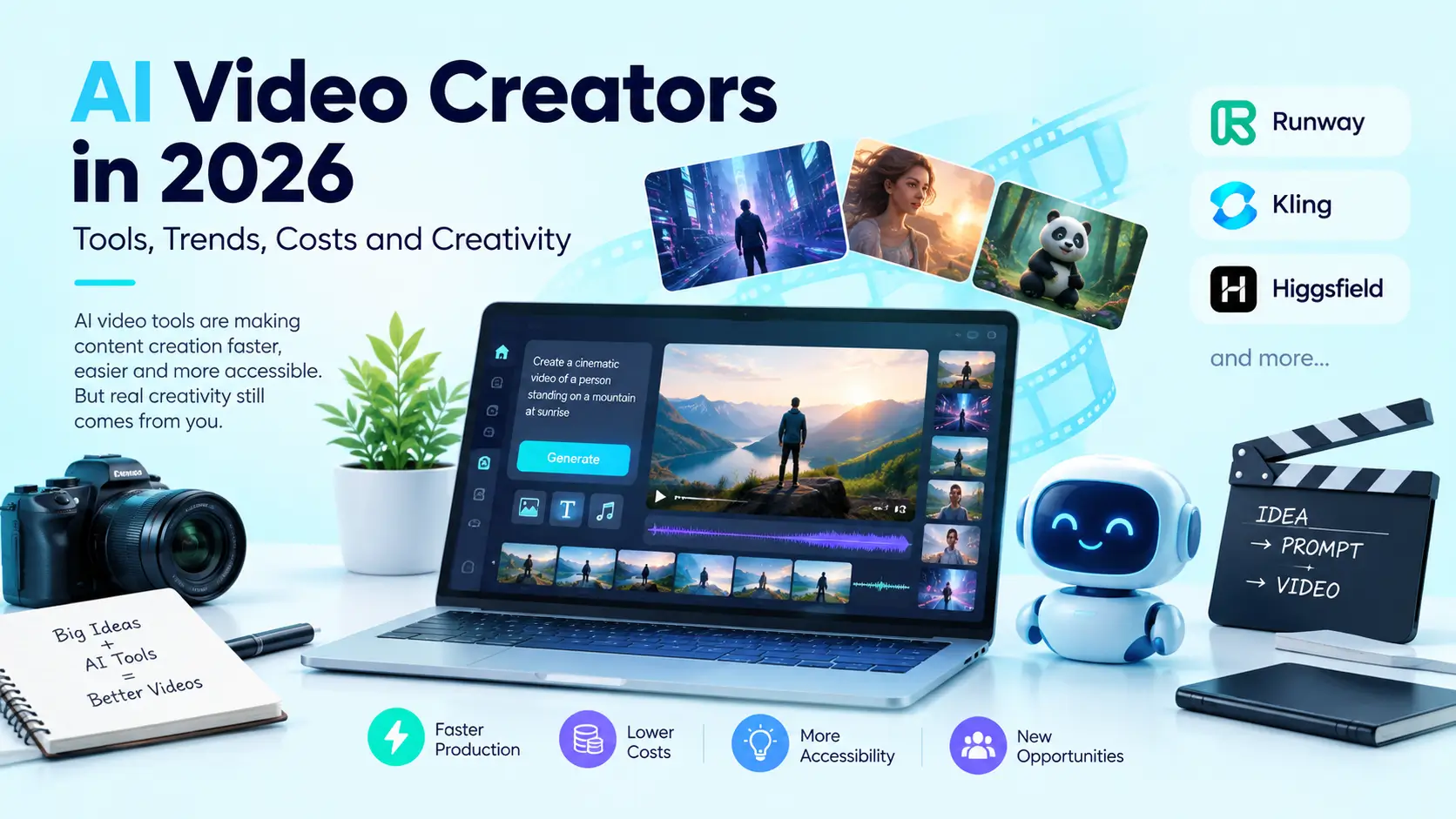
AI video creators are changing how people make films, social media videos, ads, and other visual content. Tools such as Runway, Kling, and Higgsfield can reduce production time and make advanced video creation more accessible. However, creators still need strong ideas, storytelling, and human direction to produce valuable content.
For readers exploring AI technology, Artificial Flux also covers practical topics such asFlux Ai and ChatGPT for beginners, helping creators understand where AI fits into modern content workflows.
How AI Video Creation Is Changing
AI video generation has moved beyond simple experiments. Today, creators can use text prompts, images, and other inputs to produce scenes, characters, animations, and marketing visuals.
This change is especially useful for independent creators and small teams. Instead of starting every project with expensive equipment and a large production crew, they can test ideas digitally and develop concepts much faster.
At the same time, AI does not automatically create great storytelling. The person behind the tool still decides what the audience should see, feel, and understand.
What AI Video Creators Think About the Technology
The response from creators is mixed. Many appreciate the speed and lower barriers, while others worry about what may disappear when more production work becomes automated.
AI Gives Creators More Creative Freedom
One major benefit is accessibility. A creator with a strong idea can now experiment with visuals that might previously have required a large budget.
Independent filmmaker Brad Tangonan, who used generative AI in his film Murmuray, described AI tools as a way for artists to express ideas they already have. His experience highlights an important point: the technology itself does not provide the creative vision. The creator does.
Therefore, AI video works best when creators use it to support their own style rather than allowing the software to make every creative decision.
Faster Production Can Have a Creative Cost
Speed is one of AI video’s biggest advantages. However, faster production does not always lead to better creative work.
Filmmaker Keenan MacWilliam raised this concern by questioning whether efficiency always benefits creativity. His point is important because generating more content is not the same as creating more meaningful content.
Creators still need time to develop ideas, review results, remove weak scenes, and shape the final story.
What Happens to Human Collaboration?
AI can allow one person to handle tasks that once required several people. This can make filmmaking more accessible, but it can also reduce collaboration.
Filmmaker Hal Watmough supported the use of AI while expressing concern about making films alone. His experience shows the other side of AI-assisted production: a smaller team can improve efficiency, but filmmaking has traditionally depended on collaboration between many creative roles.
This balance will remain important as AI video tools become more capable.
Runway and the New Economics of Filmmaking
Runway is one of the companies helping shape the future of AI video production. Its CEO, Cristóbal Valenzuela, has argued that AI could allow studios to distribute a large film budget across many projects instead of putting most of the money into one expensive production.The idea is simple: if technology lowers production costs, studios could take more creative risks and produce a larger number of films.
This approach could create opportunities for independent filmmakers and smaller studios. More affordable production may also make it easier to test unusual concepts that would be too expensive under traditional production methods.However, producing 50 projects instead of one does not guarantee 50 successful stories. Creative quality still depends on the people developing and editing those projects.
Kling and the Growing AI Video Model Market
Kling is another important name in AI video generation. Alongside Runway and other models, it shows how quickly the AI video market is expanding.Creators increasingly have access to several models with different strengths.
One platform may produce a useful cinematic scene, while another may perform better for movement, characters, or a particular visual style.As a result, many professional users may not depend on one AI video generator. Instead, they can combine different tools according to the requirements of each project.
Higgsfield Brings AI Video to Businesses
The business side of AI video is growing quickly as well. Higgsfield has positioned itself as a platform that brings multiple AI video models together, including models such as Kling, Veo, and Sora. In August 2026, the company announced a $400 million funding round at a $5.4 billion valuation and said it served hundreds of Fortune 500 companies.
This development shows that AI video is moving beyond individual creators. Businesses are increasingly interested in using AI for regular marketing and creative workflows.
Why Businesses Use AI Video
Companies can use AI video for many types of content, including:
- Social media campaigns
- Product demonstrations
- Advertising concepts
- Promotional videos
- Training materials
- Creative testing
- Short-form marketing content
For large teams, having several AI models available through one platform can also reduce the need to manage multiple subscriptions and separate workflows.
The Real Cost of AI Video Generation
AI video can look inexpensive when you only consider the monthly subscription. The actual cost can be higher because creators often need several attempts before getting a usable result.
A single prompt may produce the wrong movement, poor character consistency, an unwanted camera angle, or another visual problem. The creator then needs to generate the scene again.Therefore, the useful number is not simply the subscription price. A better question is:
How much does it cost to create one finished video?
For example, a creator might generate five versions of a short scene before keeping one. When this happens across an entire project, credits can disappear much faster than expected.
Understanding the cost per successful generation can help creators choose an AI video platform more wisely.
A Real Creator Experience: More Freedom, Less Collaboration
Imagine an independent filmmaker who previously needed a small crew to create a short visual story. With AI video tools, that creator can now develop scenes, experiment with styles, and produce early versions without coordinating a large team.That freedom can be powerful. The filmmaker has more control and can experiment with ideas that may have been too expensive before.
However, the same workflow can feel isolating. Without actors, editors, designers, and other collaborators contributing ideas, the creator may lose the unexpected moments that often appear during teamwork.This tension between independence and collaboration is one of the most interesting parts of the AI filmmaking discussion.
AI Video vs Traditional Filmmaking
AI video and traditional filmmaking each have different strengths.
| Factor | AI Video | Traditional Filmmaking |
| Production speed | Usually faster | Often slower |
| Initial production cost | Can be lower | Usually higher |
| Team size | Can be very small | Often requires multiple roles |
| Experimentation | Easy to test ideas | Testing can cost more |
| Human collaboration | May be limited | Usually central |
| Creative control | Prompt-based and iterative | Direct physical production |
| Scaling content | Highly flexible | Requires more resources |
The best choice depends on the project. Some creators may use AI for concept development and visual experiments while relying on traditional production for the final work.
How to Choose an AI Video Generator
There is no single AI video tool that is perfect for everyone. Before paying for a platform, consider what you actually need.
1. Check Video Quality
Look at realistic movement, lighting, characters, camera motion, and scene consistency.
2. Compare Generation Costs
Check how credits work and estimate how many generations you normally need for one finished scene.
3. Test Different Creative Styles
Try several prompts before committing. A tool that looks impressive in demonstrations may not match your preferred style.
4. Consider Your Workflow
Creators should also check editing features, image-to-video support, commercial use, export options, and integration with other tools.
5. Think About Your Audience
A filmmaker, social media creator, marketing agency, and online store may all need different types of AI video features.
Is AI Video Replacing Human Creativity?
AI video is changing creative work, but replacing human creativity is a different question.AI can generate scenes, follow prompts, and speed up repetitive production tasks. Yet humans still decide what story to tell and why that story matters.
A strong result usually requires creative direction, prompt refinement, selection, editing, and final judgment. In other words, AI can produce possibilities, but the creator decides which possibilities are worth keeping.
Why AI Video Matters for Marketers
Marketing teams can benefit from AI video because campaigns often require many variations.A company may need different videos for social platforms, product pages, advertisements, and different audience groups.
AI can help teams create and test these variations faster.This does not mean every generated video should be published. Human review remains important for brand quality, accuracy, messaging, and consistency.
The Future of AI Video Creators
AI video technology is moving from simple experiments to practical tools for filmmaking, marketing, and social media. Platforms like Runway, Kling, and Higgsfield are helping creators produce videos faster and at lower cost.
However, human creativity still matters. AI can create visuals, but people provide storytelling, direction, editing, and creative ideas. The future of AI video creation will likely combine AI tools with human creativity to produce better and more original content.
Frequently Asked Questions
What are AI video creators?
AI video creators use AI tools to generate, edit, and enhance videos from text prompts, images, or other inputs.
What is the best AI video generator in 2026?
The best AI video generator depends on your video quality, budget, speed, features, and creative needs.
Is AI video cheaper than traditional filmmaking?
AI video can lower production costs, but repeated generations and credit-based plans can increase overall expenses.
Can AI make a complete movie?
AI can create many movie elements, but human storytelling, direction, editing, and creative decisions are still important.
Is AI video replacing filmmakers?
AI is changing filmmaking workflows, but human filmmakers remain essential for storytelling, creativity, and direction.
Is Runway better than Kling?
Runway and Kling have different strengths, so the better choice depends on your project and video requirements.
Why are businesses using AI video?
Businesses use AI video to create marketing content faster, test ideas, and produce more content at scale.
Does AI video reduce creativity?
AI can limit creativity when overused, but it can also help creators explore ideas that were previously difficult or expensive to produce.
Final Thoughts
AI video creators now have powerful tools such as Runway, Kling, and Higgsfield to produce videos faster and with fewer resources. However, successful AI video production still depends on human creativity, storytelling, editing, and creative direction. As AI video technology continues to improve, creators and businesses can use these tools to experiment with new ideas, streamline production, and create engaging visual content without losing the human element behind the story.