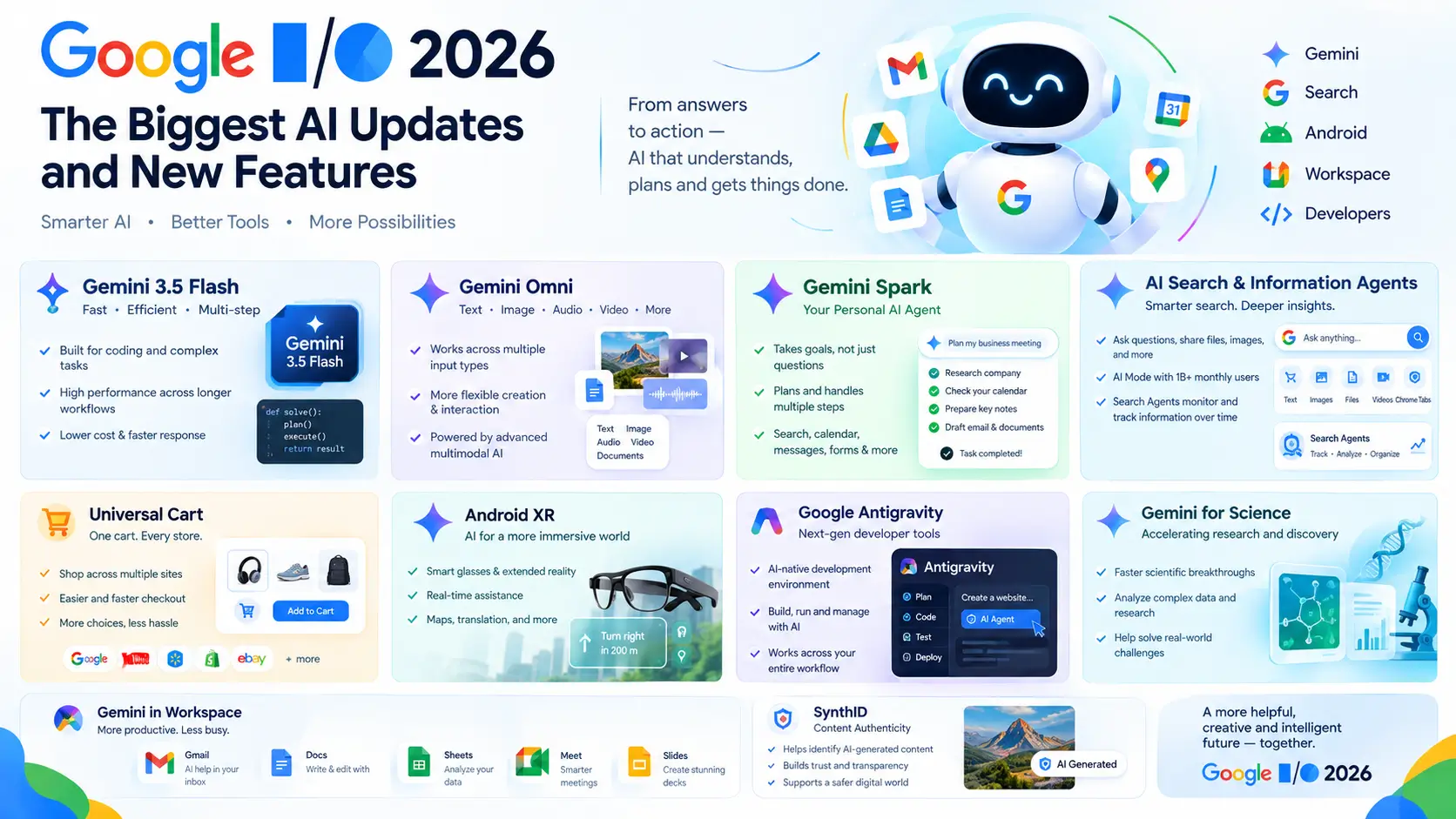
Google I/O 2026 introduced major AI updates across Gemini, Google Search, Android, Workspace, and developer tools, showing how artificial intelligence is moving beyond simple answers toward systems that can understand tasks and take action. Google announced new Gemini models, AI agents, smarter Search features, Android XR and smart glasses, advanced developer tools, AI-powered scientific research, and deeper AI features for Workspace, making AI more useful for everyday work, search, development, and research.
If you are already exploring tools such as ChatGPT or Claude, these changes are important because they show where the wider AI industry is heading: toward software that can understand information, make decisions, and complete tasks with less human input.
What Changed at Google I/O 2026?
The biggest change was not one single product. It was Google’s wider move toward agentic AI.
Traditional AI usually waits for a question and then gives an answer. New AI agents are designed to do more than provide answers they can take actions and complete tasks. They can break a goal into smaller steps, use different tools, and complete multiple actions to achieve a specific outcome.
Google’s 2026 announcements followed this vision across Gemini, Search, developer platforms, Workspace, and Android, with Artificial Flux covering the latest AI developments and tools.
Gemini Moves From Assistant to AI Agent
Gemini Spark
One of Google’s most notable announcements was Gemini Spark, a personal AI agent designed to do more than respond to prompts.Instead of asking Gemini each question separately, users can describe the result they want. Google AI Ultra was also reported to have a major price cut, making its pricing an important part of Google’s competition in the premium AI market. However, users should look beyond price when choosing an AI service. Key factors include available features, usage limits, and how well the tools support their daily work.
This represents an important change in how people may interact with AI. Rather than simply asking an AI for instructions, users could eventually give it a goal and let it work through the process.Google also discussed future capabilities such as custom sub-agents and payment authorization with safeguards. These features could make AI agents more useful for real-world tasks, although users will still need control over important actions.
Why AI Agents Matter
Imagine telling an AI that you need to prepare for a business meeting.A traditional chatbot might give you a checklist. An AI agent could potentially research the company, organize information, prepare notes, check your calendar, and create supporting documents.That difference is one of the most important themes behind the Google I/O 2026 AI updates.
New Gemini Models Bring More Speed and Capability
Google also announced several developments across its Gemini model family.
Gemini 3.5 Flash
Gemini 3.5 Flash is a fast AI model built for demanding tasks such as coding and longer workflows. Instead of focusing only on quick answers, it aims to deliver reliable performance across multiple steps of a task.
For developers, model speed and cost are especially important. Faster and less expensive AI models can make it easier to build applications that depend on repeated AI requests.
Gemini Omni
Gemini Omni takes Google’s multimodal approach further by working across different types of input and output.Video is an important part of the announcement, with Google positioning the model around more flexible creation and interaction.
Multimodal AI is becoming increasingly important because people do not communicate only through text. Images, video, audio, documents, and other data can all provide useful context.
Gemini 3.5 Pro
Google also confirmed Gemini 3.5 Pro as a more capable model in the Gemini family.For users and developers, the growing range of Gemini models means that AI tools are becoming more specialized. A fast AI model can handle everyday tasks efficiently, while a more powerful model may work better for complex reasoning, coding, and development tasks.
Google Search Is Becoming More Interactive
Search was another major part of Google I/O 2026.
Instead of treating Google Search as a simple box where users type keywords, Google is moving toward an experience where people can ask questions, provide files, share images, and interact with AI-generated research.
AI Mode in Google Search
Google’s AI Mode has become a major part of its search strategy. The company reported more than one billion monthly users for AI Mode and said queries were growing rapidly.
The important change is that Search can now handle more types of information.
Users can work with:
- Text
- Images
- Files
- Videos
- Chrome tabs
This can make research easier because users do not always need to convert everything into a written search query.
For example, someone could provide a document and ask questions about its contents instead of searching for each piece of information separately.
Search Agents
Google is also developing Search Agents that can monitor information over time.
This could be useful when someone needs to follow a changing topic rather than search for it once. An agent could watch for developments, identify changes, and organize relevant information.
That moves Search closer to an ongoing research assistant.
AI-Powered Shopping
Google also introduced shopping-related AI features, including price tracking, deal discovery, and product compatibility checks.
The broader idea is simple: instead of only helping users find products, AI can help them compare and evaluate options before making a purchase.
AI Glasses Could Bring Gemini Into the Real World
AI is also moving beyond phones and computers.
Google’s Android XR strategy includes smart glasses that can provide AI-powered audio without requiring a traditional display. The first AI-powered smart glasses were planned for fall 2026 through partnerships with Samsung, Qualcomm, Gentle Monster, and Warby Parker.
The goal goes beyond simply adding AI to glasses. These devices aim to give people access to AI while they work, walk, travel, or interact with their surroundings. They are also designed to work with both Android phones and iPhones, making wearable AI more accessible. Future versions could add visual displays for a more immersive AI experience.
Google Makes AI Agent Development Easier
AI agents are only useful at scale if developers can actually build and manage them.This is where Google’s developer announcements become important.
Antigravity 2.0
Google Antigravity 2.0 is focused on helping developers create AI agents and coordinate multiple agents.Instead of building one large AI system that handles everything, developers can create specialized agents that work together.
For example, one agent could research information, another could analyze it, and another could prepare the final result.Google also announced tools such as a desktop application, voice support, a command-line interface, an SDK, and Firebase integration.
Managed Agents
Managed Agents are another important part of the platform.They can provide an environment where AI agents can reason, plan, execute code, and browse the web.For developers, this can reduce the amount of infrastructure they need to build themselves.
Google AI Studio
Google AI Studio also received improvements for app development.The ability to move from AI-assisted development toward Android app publishing could make the process easier for developers and smaller teams.This is particularly useful for people who have an idea for an app but do not want to build every part of the development process manually.
Gemini for Science Targets Research
Not every Google I/O announcement was designed for everyday users.Google also introduced Gemini for Science, which focuses on scientific research and life sciences.The platform includes several research-focused capabilities.
Hypothesis Generation
AI can help researchers explore different possible explanations and compare ideas.
Computational Discovery
Researchers can use AI to generate and evaluate different approaches using computational methods.
Literature Insights
Scientific papers can be turned into structured information that researchers can search and analyze more easily.
Science Skills
The system can connect AI workflows with scientific databases and research resources.
These tools could eventually have a much larger impact than their relatively quiet launch suggests. If AI can help researchers work faster in areas such as biology, medicine, or materials science, the results could extend far beyond the technology industry.
SynthID Focuses on Trust in AI Content
As AI-generated images, videos, audio, and text become more common, people need better ways to identify synthetic content. Google SynthID helps address this challenge by adding invisible watermarks to AI-generated content.
Google also discussed C2PA Content Credentials, which can show where digital content came from and how someone edited it. These tools could help journalists, businesses, creators, social platforms, and everyday users verify online content and better understand its origin.
Google Workspace Gets More AI Features
Google is also bringing AI deeper into the apps people already use for work.
Gmail
AI features can help identify important emails and prepare suggested responses.
Google Docs
Users can speak their ideas while AI helps organize them into a clearer structure.
Google Keep
Voice notes can be turned into more organized and searchable information.
Daily Brief
Google is also working on personalized summaries that combine information from areas such as email, calendar, and tasks.These features may sound less dramatic than AI agents or smart glasses, but they could have a direct impact on everyday productivity.
For example, a small business owner could start the morning with important emails, upcoming meetings, and unfinished tasks organized in one place instead of checking several applications separately.
Google AI Pricing and Subscription Updates
Google also updated its AI subscription plans in 2026. Google AI Pro and AI Ultra provide higher usage limits and access to advanced AI features. Google AI Ultra also received a reported price cut, strengthening Google’s position in the premium AI market. However, price alone should not decide which AI service is best. Users should compare features, usage limits, and how well the tools fit their daily work.
What Google I/O 2026 Means for AI
Looking at all these announcements together reveals a much bigger trend.
Google is connecting AI across different parts of its ecosystem.Gemini is becoming more capable. Search is becoming more interactive. AI agents are being developed to perform tasks. Smart glasses could bring AI into everyday environments, while Workspace brings automation into work.Developers are also getting better tools for building their own AI applications.This means the future of AI may not be about opening one chatbot whenever you need help. Instead, AI could gradually become part of the software and devices people already use.
How Google Compares With the Wider AI Market
Google has one major advantage: distribution.
Search, Android, Gmail, YouTube, Workspace, and other Google services already reach enormous numbers of people.That gives Google an opportunity to introduce AI features directly into products users already know.
However, the AI industry remains highly competitive. OpenAI, Anthropic, and other companies are also developing stronger models, AI agents, coding tools, and enterprise products.Google therefore has the technology and distribution to compete, but the real test will be whether these products work reliably in everyday situations.
Which Google I/O 2026 Updates Matter Most?
| Update | Main Users | Why It Matters |
| Gemini Spark | Everyday users | Moves AI toward task completion |
| Gemini 3.5 Flash | Developers and businesses | Faster AI workflows |
| AI Search | General users | Makes search more interactive |
| AI Search Agents | Researchers and professionals | Supports ongoing research |
| Android XR glasses | Mobile users | Brings AI into real-world situations |
| Antigravity 2.0 | Developers | Simplifies agent development |
| Gemini for Science | Researchers | Supports scientific discovery |
| SynthID | Creators and platforms | Helps identify AI-generated content |
| Workspace AI | Professionals | Reduces repetitive work |
Frequently Asked Questions
What is Google I/O 2026?
Google I/O 2026 is Google’s developer conference where the company presented new products, AI models, developer technologies, Search features, and updates across its ecosystem.
What is Gemini Spark?
Gemini Spark is an AI agent designed to perform multi-step tasks instead of only answering individual questions.
What is Gemini 3.5 Flash?
Gemini 3.5 Flash is a faster Gemini model designed for tasks such as coding, AI workflows, and longer multi-step processes. As a result, it can help users handle demanding tasks more efficiently while maintaining performance across different steps.
Is Google Search becoming an AI assistant?
Yes. Google’s Search strategy is moving toward AI-powered interactions, multimodal queries, research agents, and shopping assistance.
What are Google’s AI glasses?
Google’s Android XR strategy includes smart glasses designed to provide AI-powered assistance, including audio-based features, while users go about their daily activities.
What is Google Antigravity 2.0?
Antigravity 2.0 is Google’s agent-focused development platform for creating and coordinating AI agents.
What is SynthID?
SynthID is Google’s technology for embedding invisible watermarks into AI-generated content to help identify its origin.
How is AI being used in GoogleWorkspace?
Google is adding AI features to Gmail, Docs, Keep, and other Workspace tools to help users organize information, manage tasks, and create content.
Will AI agents replace normal chatbots?
AI agents can do more than traditional chatbots, but they will not replace every chatbot use case. Simple questions and basic conversations may still work better with a standard conversational AI, while AI agents can handle more complex tasks and workflows.
Final Thoughts
Google I/O 2026 showed how AI is moving beyond chat toward action, automation, and smarter digital tools. With advances in Gemini, AI agents, Search, devices, and research, Google is making AI more useful in everyday work. These Google I/O 2026 AI updates highlight the next phase of artificial intelligence, and Artificial Flux will continue covering the latest AI tools and technologies.
[…] readers new to AI music, what is Windsurf AI and what is Google I/O can also provide useful context about how generative AI tools are changing creative […]