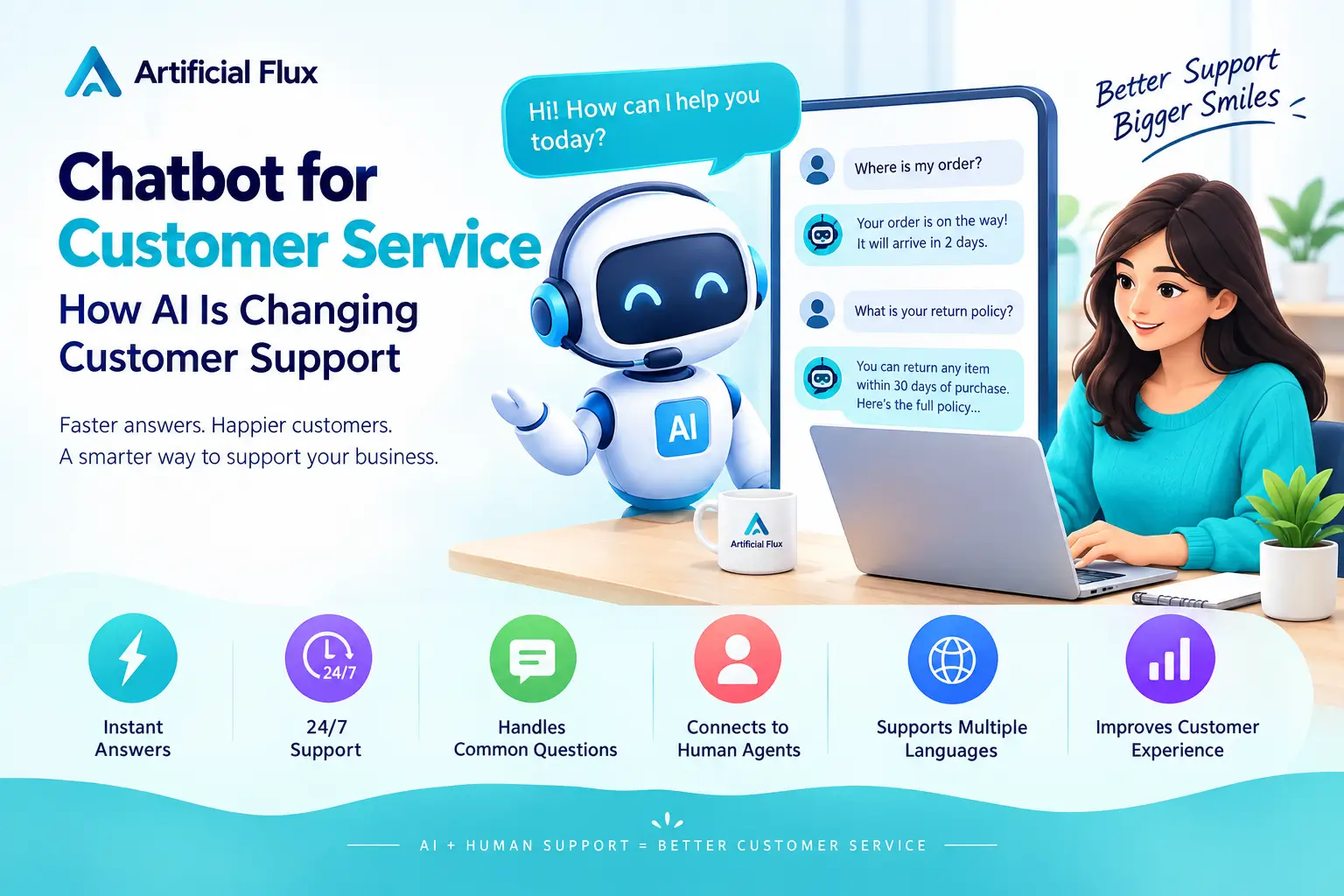
Customer service is important for every business because customers want fast and helpful answers. A chatbot for customer service can answer common questions, share product or service information, collect basic customer details, and guide users to the right solution. This helps businesses save time and handle more customer questions without making people wait.
AI chatbots can also understand natural language and respond in a more conversational way. However, they cannot handle every situation on their own. Complex problems, complaints, and sensitive issues may still need a human agent. For this reason, the most effective approach is often to combine AI chatbots with human support.
What Is a Chatbot for Customer Service?
A customer service chatbot is a software tool that communicates with customers through messages. It can be added to a website, messaging app, social media platform, or other digital channel. At Artificial Flux, businesses can use AI-powered solutions to make customer communication faster and easier.
For example, a customer may ask:
- What is the price?
- What are your business hours?
- Do you offer delivery?
- How can I place an order?
- Where is my order?
- What is your return policy?
Instead of waiting for a customer service agent, the chatbot can provide an answer immediately.
This makes customer support faster and easier.
How Does a Customer Service Chatbot Work?
A chatbot receives a customer’s message and tries to understand what the customer needs.
It then gives an answer based on its instructions, business information, or connected data.
A simple chatbot may use fixed questions and answers.
An AI chatbot can understand more natural language and may handle different ways of asking the same question.
For example:
Customer: “How much does this cost?”
Customer: “What’s the price?”
Customer: “Can you tell me the price?”
These questions are written differently, but they have the same purpose.
An AI-powered chatbot can often understand this type of conversation.
What Can a Customer Service Chatbot Do?
A chatbot can handle many common customer service tasks.
1. Answer Frequently Asked Questions
Chatbots can answer questions about products, services, prices, opening hours, shipping, returns, and other common topics.
2. Provide Product Information
Customers can ask about features, sizes, colors, availability, or other product details.
3. Help Customers Find Information
A chatbot can guide visitors to the correct page, product, service, or resource.
4. Collect Customer Information
It can ask for basic information such as a name, email address, order number, or the reason for contacting support.
5. Help With Orders
Depending on the system, a chatbot can help customers start an order or find basic order information.
6. Send Customers to a Human Agent
If the chatbot cannot solve a problem, it can transfer the conversation to a customer service representative.
Why Are Chatbots Becoming Popular?
Customers expect businesses to respond quickly.They may not want to wait several hours or even a full day for a simple answer.A chatbot can provide instant support for many basic questions.
It can also work 24 hours a day, depending on the system and service being used.This can be helpful for businesses that have customers in different countries and time zones.A customer may contact a business when its support team is offline. The chatbot can still provide basic information until a human agent becomes available.
Chatbots for Websites
A website chatbot can help visitors while they are browsing a website.
For example, someone may visit an online store and ask:
“Do you have this product in another size?”
The chatbot can provide available information or guide the visitor to the right product page.
A website chatbot can also help visitors:
- Find products
- Learn about services
- Get answers to common questions
- Contact support
- Find important website pages
- Start a purchase or booking
This can make a website easier to use.
Chatbots for WhatsApp and Messaging Apps
Many businesses communicate with customers through messaging apps.
A chatbot can automate some of these conversations.
For example:
Customer: “Is my order shipped?”
Chatbot: “Please enter your order number.”
The customer provides the number, and the system can return the available order information if the chatbot is connected to the business’s order system.
The exact features depend on the messaging platform and the technology used.
Can AI Chatbots Understand Different Languages?
Modern AI chatbots can support multiple languages, depending on the AI system and how the chatbot is configured.This can be especially useful for international businesses.Customers may communicate in English, Spanish, French, Arabic, German, Hindi, Urdu, or other languages.
However, businesses should always test their chatbot in the languages their customers use.A chatbot should not only understand the language but also provide clear and useful answers.
Can a Chatbot Replace Human Customer Service?
A chatbot can handle many simple customer questions, but it should not always replace human agents.
Some problems need human understanding.
For example, a customer may have:
- A serious complaint
- A billing problem
- A complicated order
- A technical issue
- A special request
- A problem that the chatbot cannot understand
In these situations, a human agent can ask questions, understand the situation, and provide a more personal solution.
That is why the goal should not always be to remove humans from customer service.
The goal should be to use technology to help customer service teams work better.
AI Chatbot vs Human Agent
Both have different strengths.
AI Chatbot
An AI chatbot is good at:
- Answering common questions
- Giving quick replies
- Handling many conversations
- Working outside business hours
- Finding basic information
- Reducing repetitive work
Human Agent
A human agent is better at:
- Understanding emotions
- Solving unusual problems
- Handling complaints
- Making decisions
- Helping with sensitive situations
- Giving personal support
A combination of both can create a stronger customer service system.
When Should a Chatbot Transfer a Customer to a Human?
A chatbot should know when it cannot help.
The customer should have an easy way to reach a human agent.
A handover may be needed when:
- The chatbot does not understand the question
- The customer asks for a human
- The customer has a complaint
- The issue involves a payment problem
- The problem is complicated
- The customer is unhappy
- The chatbot does not have enough information
This creates a better experience because customers do not have to repeat the same problem again and again.
AI Chatbot vs Rule-Based Chatbot
Not every chatbot works in the same way.
Rule-Based Chatbot
A rule-based chatbot follows predefined rules.
For example:
Bot: “Choose an option.”
- Product Information
- Order Support
- Contact Us
The customer selects an option and continues through the conversation.
This type of chatbot can work well for simple tasks.
AI Chatbot
An AI chatbot can understand natural language more easily.Customers can ask questions in their own words instead of following a strict menu.AI chatbots can also be more flexible when handling different types of questions.The right choice depends on what the business needs.
Can Chatbots Take Orders?
Yes, chatbots can help customers with ordering.
For example:
Customer: “I want to order a blue hoodie.”
Chatbot: “What size would you like?”
Customer: “Large.”
Chatbot: “Please provide your delivery information.”
A chatbot can collect the required information and help move the customer through the buying process.
For advanced systems, the chatbot may also connect with inventory, order management, or e-commerce software.
Can Chatbots Handle Payments?
Some chatbot systems can connect customers with payment systems.
However, payment information must be handled carefully.
Businesses should use secure payment methods and trusted payment providers.
A chatbot should guide customers to a secure payment process instead of asking them to share sensitive financial information in a normal conversation.
Benefits of Using a Chatbot for Customer Service
A well-designed chatbot can provide several benefits.
Faster Responses
Customers can receive answers quickly instead of waiting for an agent.
24/7 Support
A chatbot can provide basic support outside normal working hours.
Less Repetitive Work
Customer service agents do not have to answer the same simple questions repeatedly.
Better Customer Experience
Quick and clear answers can make it easier for customers to get help.
More Support at the Same Time
A chatbot can handle many conversations at once, depending on the technology and setup.
Support for Global Customers
Businesses with customers in different countries can use chatbots to provide basic assistance across different time zones and languages.
Common Chatbot Mistakes to Avoid
A chatbot can be helpful, but poor design can create a bad customer experience.
1. Making the Conversation Too Complicated
Customers should not have to click through many options to get a simple answer.
2. Giving Very Long Answers
Keep chatbot messages short, clear, and easy to read.
3. Giving Wrong Information
Always keep product details, prices, policies, and business information updated.
4. Hiding Human Support
Customers should have a clear way to contact a real person.
5. Trying to Automate Everything
Some conversations need human attention.
6. Not Testing the Chatbot
Test the chatbot with different questions, spelling mistakes, and ways of speaking before launching it.
How to Create a Customer Service Chatbot
Building a useful chatbot starts with a clear plan.
Step 1: Find Common Customer Questions
Look at your emails, messages, live chats, and support tickets.
Find the questions customers ask most often.
Step 2: Decide What the Chatbot Should Do
Do you want it to answer questions, collect leads, help with orders, provide product information, or do several tasks?
Start with the most useful tasks.
Step 3: Choose Your Platform
Decide where customers will use the chatbot.
It could be your website, WhatsApp, social media, or another messaging platform.
Step 4: Prepare Good Answers
Write simple and helpful answers.
Avoid complicated language.
Step 5: Add Human Handover
Give customers an easy way to reach a human agent.
Step 6: Test Everything
Try different questions and conversations.
Make sure the chatbot gives useful answers.
Step 7: Improve It Over Time
Customer questions change.
Review conversations regularly and update the chatbot when needed.
How Much Does a Customer Service Chatbot Cost?
There is no fixed price for a chatbot.
The cost depends on the features and level of customization.
A basic chatbot may be simple and less expensive, while a custom AI chatbot with advanced integrations can require more development.
Factors that can affect the cost include:
- AI features
- Number of platforms
- Number of users or conversations
- Custom design
- Business integrations
- E-commerce features
- CRM integration
- Ongoing maintenance
Businesses should first decide what they need before choosing a chatbot solution.
How to Measure Chatbot Success
After launching a chatbot, businesses should check whether it is actually helping customers.
Important things to track include:
- Number of conversations
- Response time
- Common customer questions
- Successful chatbot conversations
- Human handovers
- Customer feedback
- Unanswered questions
- Customer satisfaction
If customers often leave the chatbot or immediately ask for a human, the chatbot may need improvement.
How to Improve Your Customer Service Chatbot
Regularly check your chatbot conversations to find questions it cannot answer.Update its information and improve unclear answers based on customer feedback.Small updates can make your chatbot more accurate and useful over time.
Is a Chatbot Good for Every Business?
Not every business needs a chatbot.
A chatbot can be especially useful for businesses that receive many repeated questions.
It may also help businesses with:
- Online stores
- SaaS products
- Service businesses
- Travel companies
- Education platforms
- Healthcare information services
- Financial service websites
- Restaurants
- Booking businesses
The important question is not:
“Does my business need AI?”
A better question is:
“What customer service problem can AI help me solve?”
The Future of AI Customer Service
AI is making customer support faster and easier. Chatbots can handle common questions and repetitive tasks.However, human support will still be important for complex problems that need understanding and judgment.The future of customer service is AI + human support, working together to give customers better service.
Frequently Asked Questions
What is a chatbot for customer service?
A chatbot for customer service is a software tool that communicates with customers and helps answer their questions automatically.
Can I add a chatbot to my website?
Yes, businesses can add chatbot technology to websites to help visitors and customers.
Can a chatbot work on WhatsApp?
Yes, businesses can use chatbot solutions with supported WhatsApp business systems and integrations.
Are chatbots available 24/7?
Many chatbots can provide automated support at any time, including outside normal business hours.
Final Thoughts
A chatbot for customer service helps businesses answer common questions, save time, and support customers faster.
But chatbots should not replace people completely. The best approach is to use AI for simple tasks and humans for complex problems.
Start small, automate common questions, and improve the chatbot based on customer needs.
[…] what is Warmwind OS, and how does it work? Unlike Claude AI or a traditional chatbot, Warmwind OS helps AI workers interact with software and complete […]
[…] may also be interested in our article about chatbots for customer service, which explains how businesses use AI to automate customer […]
[…] another major AI model platform. For businesses building automated support systems, our guide to chatbots explains how AI can be used in customer-facing […]
[…] exploring other AI tools, you can also read our article about what Claude AI is and our guide to AI chatbots for customer […]
[…] you’re interested in using AI for customer communication, you can also explore our guide on chatbots for customer […]