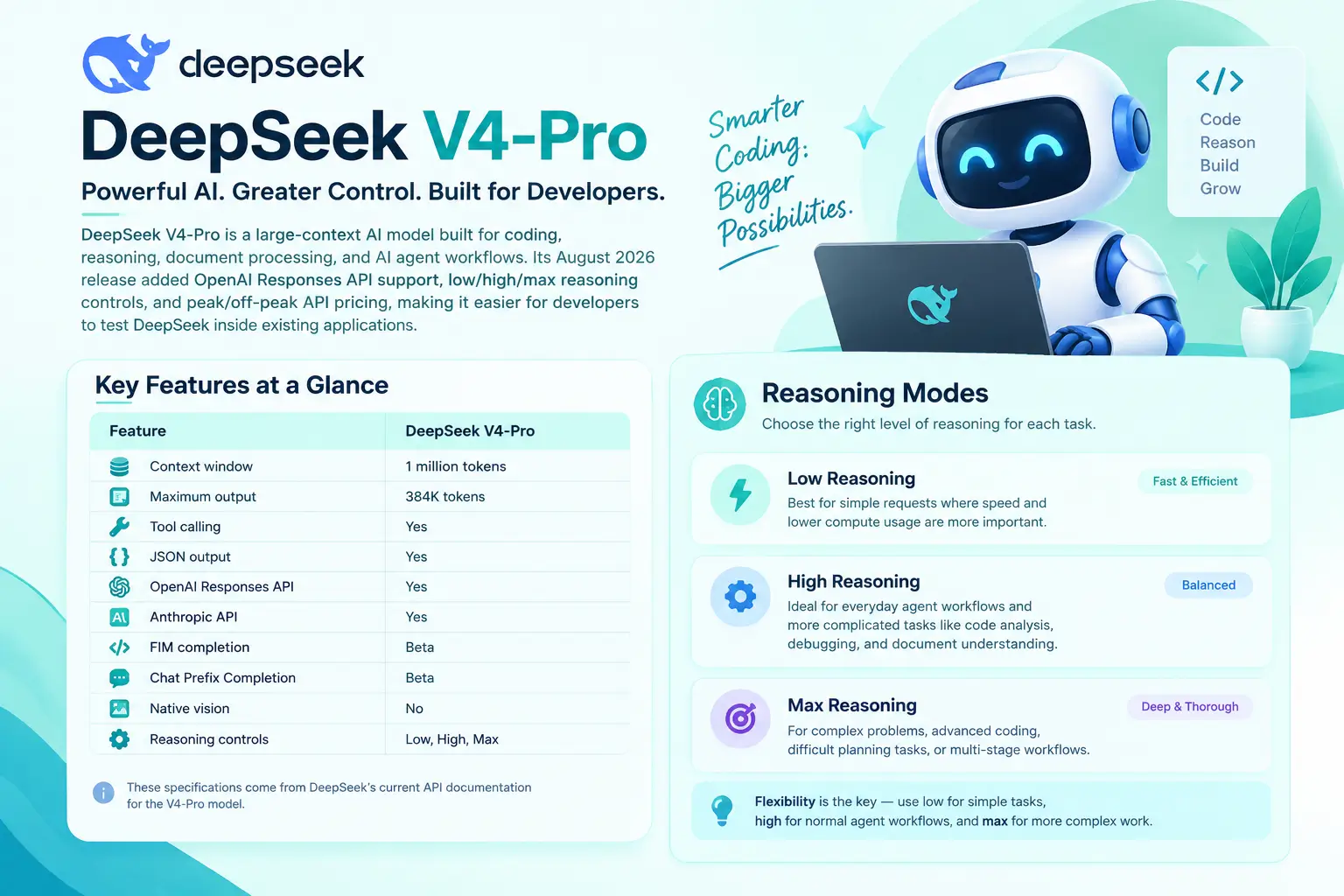
DeepSeek V4-Pro is a large-context AI model built for coding, reasoning, document processing, and AI agent workflows. Its August 2026 release added OpenAI Responses API support, low/high/max reasoning controls, and peak/off-peak API pricing, making it easier for developers to test DeepSeek inside existing applications.
If you are exploring different AI models for development, you can also read our article onClaude AI? to understand another major AI model platform. For businesses building automated support systems, our guide to chatbots explains how AI can be used in customer-facing workflows.
DeepSeek continues updating its model lineup, including V4.1-Flash and changes to the deepseek-v4-pro identifier.Artificial Flux covers DeepSeek API, pricing, and model updates to help developers understand these changes.
What Is DeepSeek V4-Pro?
DeepSeek V4-Pro is part of DeepSeek’s V4 model family, designed around long-context reasoning and agentic workloads.
The original V4 preview described V4-Pro as a 1.6 trillion parameter Mixture-of-Experts model with 49 billion active parameters. The architecture was designed to handle large amounts of information while activating only part of the model for each token.
The production V4-Pro-0813 release focused heavily on software engineering and AI agent performance.
DeepSeek reported improvements across coding and agent benchmarks, including Terminal-Bench 2.1, DeepSWE, NL2Repo, CyberGym, and other tests.For developers, however, the model size is less important than what the API can actually do.
V4-Pro supports a 1-million-token context window, up to 384K maximum output, tool calls, JSON output, the Responses API, and Anthropic-compatible API access.This makes it relevant to applications that work with large codebases, lengthy documents, multi-step agent tasks, and structured AI workflows.
DeepSeek V4-Pro Features at a Glance
The main capabilities of the original V4-Pro-0813 model include:
| Feature | DeepSeek V4-Pro |
| Context window | 1 million tokens |
| Maximum output | 384K tokens |
| Tool calling | Yes |
| JSON output | Yes |
| OpenAI Responses API | Yes |
| Anthropic API | Yes |
| FIM completion | Beta |
| Chat Prefix Completion | Beta |
| Native vision | No |
| Reasoning controls | Low, High, Max |
These specifications come from DeepSeek’s current API documentation for the V4-Pro model.
The combination of long context and tool support is especially useful for AI coding assistants and autonomous workflows.
DeepSeek V4-Pro Reasoning Modes
One of the most useful changes in the GA release was more control over reasoning effort.
DeepSeek introduced three reasoning levels for V4-Pro:
Low Reasoning
Low effort is intended for relatively simple requests where speed and lower compute usage are more important than extended reasoning.
For example, a developer could use it for basic text processing, straightforward transformations, or simpler coding tasks.
High Reasoning
High effort is designed for everyday agent workflows and more complicated tasks.
It can be useful for code analysis, debugging, document understanding, and tasks involving several steps.
Max Reasoning
Max provides the highest reasoning effort for difficult problems.
Developers may choose this mode for complex debugging, advanced coding problems, difficult planning tasks, or workflows where the model needs to reason through multiple stages.
The important advantage is flexibility.
Instead of using maximum reasoning for every request, an application can choose the effort level according to the complexity of each task. DeepSeek specifically describes low for simple tasks, high for normal agent workflows, and max for more complex work.
Why OpenAI Responses API Support Matters
For developers, API compatibility can be more important than a model’s marketing features.
DeepSeek V4-Pro added native support for the OpenAI Responses API in its August 2026 GA release. DeepSeek also provides an OpenAI-compatible base URL at https://api.deepseek.com.
This means developers who already understand the OpenAI API structure can test DeepSeek without designing an entirely new integration from scratch.
A typical migration involves changing the provider configuration, API key, and model selection while testing the application against DeepSeek.
However, compatibility does not mean identical behavior.
Developers should still test:
- Tool calls
- Structured outputs
- Streaming
- Error handling
- Token usage
- Response quality
- Latency
- Multi-turn conversations
DeepSeek’s Responses API is also stateless. For multi-turn applications, the client needs to provide the relevant conversation history rather than assuming the server will automatically store the conversation.
That detail matters when building production chatbots and AI agents.
DeepSeek V4-Pro Pricing
Pricing is one of the most important parts of the V4-Pro story.
DeepSeek introduced peak and off-peak pricing when V4-Pro reached general availability. Off-peak rates were set at half the peak rates.
The current DeepSeek pricing documentation lists the following V4-Pro rates:
| Usage | Off-Peak | Peak |
| Cache-hit input / 1M tokens | $0.022 | $0.044 |
| Cache-miss input / 1M tokens | $0.66 | $1.32 |
| Output / 1M tokens | $1.98 | $3.96 |
Peak hours are 01:00–04:00 UTC and 06:00–10:00 UTC from Monday to Friday. Other hours are classified as off-peak.
This structure creates a different cost calculation for real-time applications and background workloads.
A system that must respond immediately during peak hours cannot simply use the off-peak rate when calculating its expected API budget.
Why Cache Hits Matter
Token pricing is not only about output.
DeepSeek separates input tokens into cache-hit and cache-miss categories.
A cache hit can cost significantly less than a cache miss. This can matter for applications that repeatedly send similar system instructions, documents, or context to the model.
For example, an AI agent that repeatedly works with the same project context may benefit more from caching than a system where every request contains completely new information.
This is why developers should estimate costs using their actual request pattern rather than looking at the output-token price alone.
Is DeepSeek V4-Pro Still Cheap?
The answer depends on when and how you use it.
At launch, V4-Pro had a much lower output price than the later peak rate. After the pricing change, the official rate became $1.98 per million output tokens during off-peak periods and $3.96 during peak periods.
Consider a simple example.
If an application generates 10 million output tokens:
- At $1.98/M, the output cost is $19.80.
- At $3.96/M, the output cost is $39.60.
That difference becomes important for high-volume AI applications.
For background jobs such as document processing or overnight data extraction, scheduling can therefore become part of the cost strategy.
Coding and AI Agent Performance
Coding and autonomous agents were major priorities for the V4-Pro GA release.
DeepSeek reported the following results for its August 13 production model:
| Benchmark | V4-Pro-0813 |
| Terminal-Bench 2.1 | 87.9 |
| DeepSWE | 62.7 |
| NL2Repo | 61.5 |
| CyberGym | 83.3 |
| Toolathlon-Verified | 74.1 |
| AutomationBench | 31.8 |
| DSBench-FullStack | 71.1 |
| DSBench-Hard | 67.2 |
These are DeepSeek-reported benchmark results, so they should not be treated as guaranteed production performance. DeepSeek notes that its Code Agent tests used a specific harness and configuration, and results may vary with different frameworks.
For that reason, developers should test V4-Pro with their own codebase and workflows.
A model can perform strongly on a public benchmark while producing different results in a real application with different prompts, tools, repositories, and evaluation criteria.
DeepSeek V4-Pro and Long-Context Applications
The 1-million-token context window is another major feature.
Large context can be useful when an application needs to process information that would normally have to be divided into many smaller requests.
Potential use cases include:
Large code repositories
Developers can provide more project context when asking an AI coding assistant to understand relationships between files.
Long documents
Legal, technical, business, or research documents can contain thousands of pages or large amounts of text.
Agent workflows
Agents often need to retain information about previous actions, tool outputs, files, and instructions.
Knowledge-intensive applications
Long context can reduce the need to repeatedly retrieve and summarize smaller pieces of information.However, a larger context window is not automatically better.Sending unnecessary information can increase token usage and make it harder for a model to focus on the most relevant details.
The Main Limitation: Vision
The original V4-Pro model does not support native vision input.
DeepSeek’s current pricing documentation lists V4-Pro as having no vision support, while the newer V4.1-Flash model supports native visual understanding.
This distinction matters for applications that need to analyze screenshots, images, charts, interfaces, or visual documents.
For a text-only coding assistant, it may not be a major problem.For an application that needs both text and image understanding, the newer V4.1-Flash model deserves attention.
DeepSeek V4.1-Flash Changes the Picture
DeepSeek introduced V4.1-Flash on September 10, 2026.
The company describes it as a new architecture designed for higher capability, faster inference, and greater throughput. It also adds native multimodal visual understanding.
DeepSeek reports strong results on several agent and coding benchmarks, including Terminal-Bench 2.1, DeepSWE, NL2Repo-Bench, and CyberGym. These are company-reported results and should be evaluated independently for specific workloads.
The new model is available through the API using:
deepseek-flash
This is an important distinction for anyone researching old V4-Pro reviews.The DeepSeek model lineup is moving quickly, so the model name and the underlying model version should always be checked before making a production decision.
What Happened to the DeepSeek V4-Pro API?
This is where current documentation requires some attention.
DeepSeek’s September 10 announcement said that requests using deepseek-v4-pro would be routed to V4.1-Flash after September 14 until V4.1-Pro becomes available.However, DeepSeek’s current English pricing and API documentation still lists DeepSeek-V4-Pro-0813 as a separate model and says API service for V4-Pro continues after September 14.
Because these official pages do not present the model status in exactly the same way, developers should check the live DeepSeek API documentation before changing production configurations.
This is particularly important for applications that depend on stable model behavior.
A Simple Developer Example
Imagine a developer has an existing AI application using an OpenAI-compatible API.
The application handles customer questions, generates structured responses, and occasionally calls external tools.
Instead of rewriting the entire application, the developer can create a separate DeepSeek test environment, change the API configuration, and send the same representative requests through the new model.
The developer can then compare:
- Response quality
- Coding accuracy
- Tool-call reliability
- Response time
- Token consumption
- Error rates
- Total API cost
This approach gives a more useful result than switching an entire production system based only on benchmark scores.
How to Use DeepSeek V4-Pro API
Developers who want to test the API can follow a straightforward process:
- Create a DeepSeek API account and generate an API key.
- Configure the OpenAI-compatible base URL as https://api.deepseek.com.
- Select the model documented for your intended workload.
- Send a small set of real application prompts.
- Test structured output and tool calls.
- Measure input and output token usage.
- Compare performance and cost with your current provider.
- Move only tested workloads into production.
DeepSeek’s official API documentation confirms compatibility with OpenAI and Anthropic SDK patterns.
Who Should Consider DeepSeek V4-Pro?
DeepSeek V4-Pro is particularly relevant to developers working on text-heavy applications.
AI coding tools
The model’s coding and agent capabilities make it relevant for code assistants and software-development workflows.
AI agents
Tool calling and reasoning controls can support applications that perform several actions instead of simply returning text.
Document analysis
The 1M-token context window can be useful for large text collections and long documents.
Automated workflows
Background tasks can potentially benefit from off-peak pricing when immediate processing is not required.
Existing API applications
OpenAI and Anthropic API compatibility makes testing easier for teams that already use compatible development patterns.
Who May Need Another Model?
V4-Pro is not suitable for every workload.
Applications that depend heavily on native image understanding need a multimodal model. DeepSeek’s newer V4.1-Flash adds this capability.Teams with strict latency requirements should also test real production traffic rather than relying on benchmark scores.
Likewise, organizations should separately evaluate security requirements, compliance needs, monitoring, reliability, support, and data-handling policies.API compatibility solves an integration problem. It does not automatically solve every production requirement.
DeepSeek V4-Pro vs V4.1-Flash
The difference can be summarized simply:
| Feature | V4-Pro-0813 | V4.1-Flash |
| Context | 1M tokens | 1M tokens |
| Tool calls | Yes | Yes |
| Responses API | Yes | Yes |
| Vision | No | Yes |
| Maximum output | 384K | 384K |
| Model generation | V4 | V4.1 |
| Main focus | Reasoning, coding, agents | Speed, agents, multimodal workloads |
DeepSeek’s current documentation lists V4.1-Flash as the newer model and V4-Pro-0813 as the previous-generation model.
For anyone researching DeepSeek today, this distinction is more useful than comparing only the model names.
Frequently Asked Questions
What is DeepSeek V4-Pro?
DeepSeek V4-Pro is a large-context AI model designed for reasoning, coding, document processing, and agent-based applications.
Does DeepSeek V4-Pro support the OpenAI API?
Yes. DeepSeek provides an OpenAI-compatible API and V4-Pro supports the Responses API format.
What is the DeepSeek V4-Pro context window?
V4-Pro supports a 1-million-token context window with a maximum output of up to 384K tokens.
What are the V4-Pro reasoning levels?
The GA release introduced low, high, and max reasoning effort levels for different task complexities.
Does DeepSeek V4-Pro understand images?
The original V4-Pro does not support native vision input. DeepSeek V4.1-Flash adds native multimodal visual understanding.
How much does DeepSeek V4-Pro cost?
Current listed V4-Pro pricing is $0.66/M for cache-miss input and $1.98/M for output during off-peak hours, rising to $1.32/M and $3.96/M during peak periods.
Can I use DeepSeek with an OpenAI SDK?
Yes. DeepSeek provides an OpenAI-compatible base URL at https://api.deepseek.com.
Is DeepSeek V4-Pro good for coding?
DeepSeek specifically improved V4-Pro’s agent and coding performance in the August GA release. However, developers should test it against their own repositories and coding tasks rather than relying only on benchmark results.
What is the latest DeepSeek model?
DeepSeek released V4.1-Flash in September 2026. It adds native multimodal understanding and is the newer model generation compared with V4-Pro-0813.
Final Thoughts on DeepSeek V4-Pro
DeepSeek V4-Pro combines a 1M-token context window, reasoning controls, tool calling, coding capabilities, and OpenAI API compatibility for developers building AI agents, coding tools, and text-based applications. Its peak and off-peak pricing also gives developers different options for managing API costs.
With DeepSeek V4.1-Flash now available, developers should check the latest model specifications, pricing, and API documentation before choosing a DeepSeek model.Testing the model with real workloads can help measure response quality, token usage, and overall API performance.
[…] AI tools are becoming more useful for everyday work, while other AI platforms such as DeepSeek V4-Pro are also adding advanced features for developers and businesses. If you’re interested in […]