If you need an AI model for coding, reasoning, images, long documents, and development tasks, Mistral Medium 3.5 is designed for these use cases. It is a 128B open-weight model with a 256K context window and configurable reasoning.
One of its main features is Mistral Vibe, an AI coding agent that can work on software projects through remote cloud environments. This helps teams like Artificial Flux assign coding tasks and review AI-generated changes later.
If you are exploring other AI tools, you can also read our article about what Claude AI is and our guide to AI chatbots for customer service.
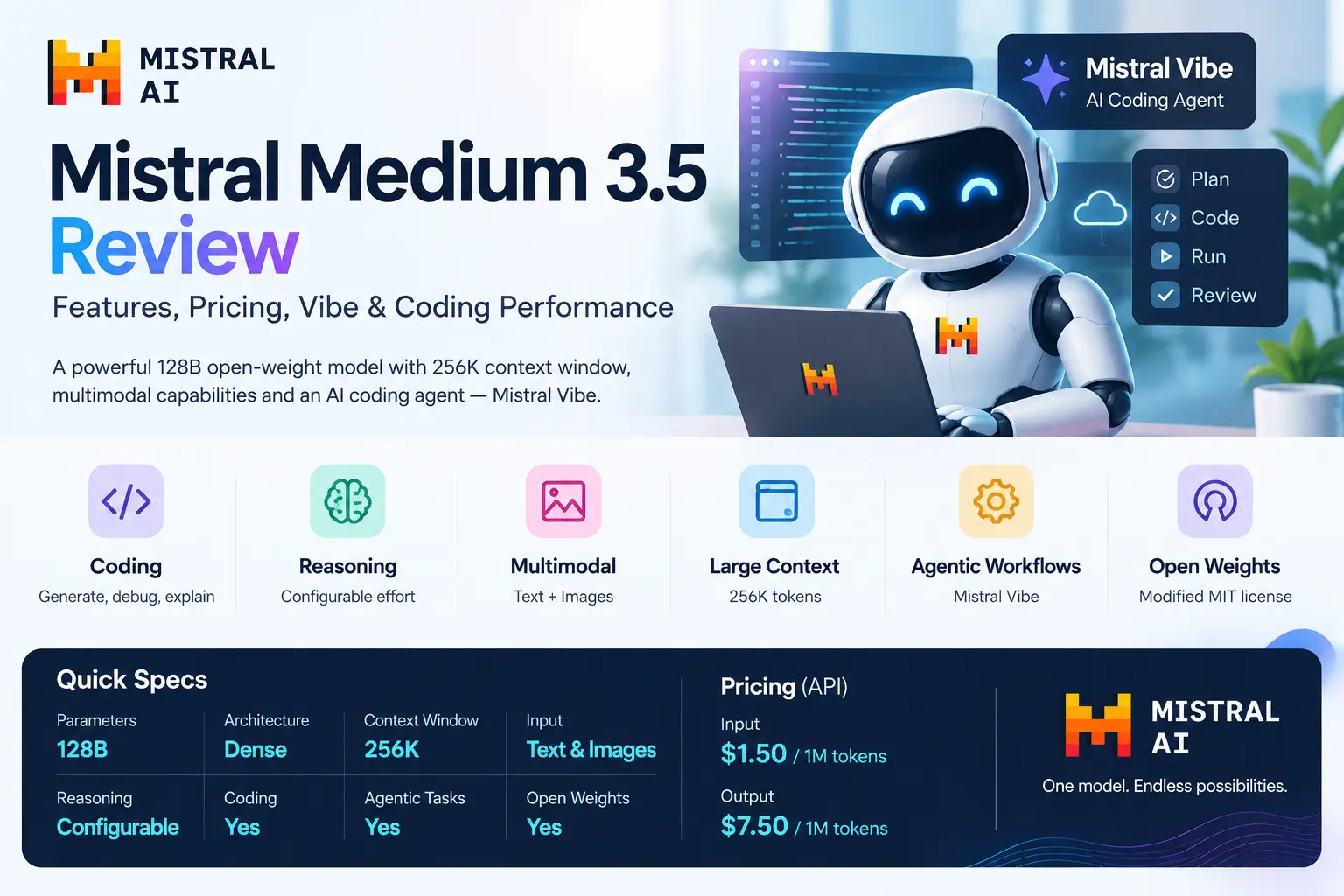
What Is Mistral Medium 3.5?
Mistral Medium 3.5 is a 128-billion-parameter dense multimodal model from Mistral AI. It combines instruction following, reasoning, coding, tool use, and visual understanding in one model.
Mistral released the model as open weights under a Modified MIT license. It is designed for agentic workflows, software development, long-running tasks, and applications that need a large context window.
Mistral Medium 3.5 at a Glance
The model offers a large 256K context window, image understanding, configurable reasoning, and coding capabilities. It is built for both normal AI tasks and more advanced agentic workflows.
Its open-weight design also gives developers the option to explore self-hosting instead of using only a hosted API.
| Feature | Details |
| Parameters | 128B |
| Architecture | Dense |
| Context window | 256K |
| Input | Text and images |
| Reasoning | Configurable |
| Coding | Yes |
| Agentic tasks | Yes |
| Open weights | Yes |
| License | Modified MIT |
| API input price | $1.50 / 1M tokens |
| API output price | $7.50 / 1M tokens |
What Makes Mistral Medium 3.5 Different?
Mistral Medium 3.5 brings several capabilities together in one model instead of requiring separate models for coding, reasoning, and multimodal tasks. This makes it suitable for applications that need more than simple text generation.
Its combination of a large context window, open weights, coding support, and agentic tools also makes it interesting for developers building AI-powered software workflows.
One Model for Coding and General Tasks
Medium 3.5 can help with code generation, debugging, explanations, reasoning, and general questions. Developers can also connect it with tools to create more advanced workflows.
This approach can reduce the need to switch between different AI models for different development tasks.
256K Context Window
Mistral Medium 3.5 supports a 256K-token context window, giving applications plenty of space for long documents, codebases, instructions, and previous conversation history.
For developers, this can be useful when working with large projects where the AI needs to understand information from multiple files at the same time.
Configurable Reasoning
The model supports configurable reasoning, allowing developers to control how much reasoning effort is used for a task.
Simple requests can use less processing, while complicated coding or reasoning problems can receive more attention from the model.
Multimodal Understanding
Medium 3.5 can work with both text and images, making it useful for tasks involving screenshots, diagrams, interfaces, and other visual information.
For example, a developer could provide a website screenshot and ask the model to explain the interface or suggest changes to the design.
Mistral Vibe: The AI Coding Agent
Mistral Vibe is one of the most notable parts of the Medium 3.5 ecosystem. It is designed to help developers complete software tasks with an AI coding agent.
Instead of asking AI for one code snippet at a time, developers can give Vibe a larger task and allow it to inspect files, modify code, run commands, and work through multiple steps.
What Can Vibe Do?
Vibe can help with tasks such as fixing bugs, creating tests, refactoring code, updating dependencies, and implementing features.
It can also work with development tools and services such as GitHub, Linear, Jira, Sentry, Slack, and Microsoft Teams.
How Remote Coding Works
Vibe can run coding work in a remote cloud environment instead of requiring everything to happen on the developer’s computer.
A developer can give the agent a task, let it work through the project, and then review the resulting changes or pull request.
GitHub and Pull Requests
When GitHub access is configured, Vibe can work with repositories and create branches or draft pull requests.
Developers can then review the generated code before deciding whether the changes should be merged.
How to Use Mistral Vibe
Using Vibe generally starts with connecting the required development environment and giving the agent a clear task.
A simple workflow looks like this:
- Connect your development project or repository.
- Describe the coding task clearly.
- Let Vibe inspect and modify the project.
- Review the changes and test results.
- Review the branch or pull request before merging.
The developer still controls the final decision and should review important code changes before they reach production.
Teleport: Continue Coding in the Cloud
Vibe also includes a Teleport feature that can move a local coding session into a remote environment.
This can be useful when a task becomes longer than expected and you want the AI agent to continue working while you are away from your computer.The remote session can continue processing the task and later return changes for review.
Mistral Medium 3.5 Performance
Mistral reports a 77.6% score on SWE-Bench Verified, a benchmark focused on real-world software engineering tasks.
The company also reports a 91.4 score on τ³-Telecom, which measures performance on tool-based and agentic tasks.
Benchmark results can provide useful information, but they do not guarantee the same performance on every real-world project.Your programming language, repository quality, tests, tools, prompts, and task complexity can all affect the final result.
Running Mistral Medium 3.5 Locally
Because Medium 3.5 is available as open weights, organizations can explore running it on their own infrastructure.
Mistral says the model can be self-hosted using as few as four GPUs, although the actual hardware requirements depend on factors such as precision, context size, and workload.
GPU Requirements
A 128B model requires substantial computing resources, especially when running long contexts or serving multiple users.
Teams should consider GPU memory, inference speed, concurrency, electricity, and server costs before choosing local deployment.
Quantized Versions
Quantization can reduce the memory required to run a large model by using lower-precision weights.
This can make local deployment more practical, but developers should test the model carefully because speed, quality, and memory requirements can change with different quantization methods.
vLLM and SGLang
Developers can use inference frameworks such as vLLM and SGLang to help serve large language models.
The best setup depends on the project’s hardware, number of users, context requirements, and expected response speed.
Mistral Medium 3.5 Pricing
Mistral lists Medium 3.5 API pricing at $1.50 per million input tokens and $7.50 per million output tokens.
Cached input tokens are priced lower, which can help applications that repeatedly send similar information to the model.
Is Mistral Medium 3.5 Expensive?
The actual cost depends on how much your application uses the model and how many output tokens it generates.
Developers should calculate both input and output usage because long AI-generated responses can increase the final API bill.
Mistral Vibe Pricing
Mistral offers different plans for Vibe, including Free, Pro, Team, and Enterprise options.
The available usage limits and features can vary between plans, so developers should check the current pricing before choosing a subscription.
Mistral Medium 3.5 License
Medium 3.5 is an open-weight model released under a Modified MIT license.
This provides flexibility for many developers, but businesses should read the current license carefully before using the model commercially.
Mistral states that companies generating more than $20 million in monthly revenue need a commercial license or must use the model through Mistral Studio.This requirement is especially important for large organizations planning a commercial deployment.
Mistral Medium 3.5 vs Claude Sonnet
Claude Sonnet is a proprietary AI model family accessed through Anthropic’s services, while Medium 3.5 provides open weights that can be considered for self-hosting.
Both models target coding, reasoning, and general AI workloads, but their deployment options and pricing structures are different.For developers, the comparison should include coding performance, context requirements, API pricing, privacy, infrastructure, and deployment flexibility.
Mistral Medium 3.5 vs GPT-4o
GPT-4o is a multimodal model designed for text, image, and general AI tasks through hosted services.
Medium 3.5 offers a different approach because developers can access its open weights and consider running the model on their own infrastructure.The right option depends on whether a project needs self-hosting, API simplicity, multimodal capabilities, or specific performance characteristics.
Mistral Medium 3.5 vs Qwen
Qwen includes open-weight models in several sizes, giving developers different choices depending on their hardware and workload.
Medium 3.5 is a 128B dense model with a 256K context window and multimodal capabilities.Smaller Qwen models may be easier to run on limited hardware, while Medium 3.5 targets more demanding workloads.
Mistral Medium 3.5 vs Kimi K2.6
Kimi K2.6 and Medium 3.5 use different model architectures and have different approaches to AI agents.
Medium 3.5 is a 128B dense model, while Kimi uses a mixture-of-experts approach.Both can be considered for coding and agentic workflows, but developers should compare the exact model versions, pricing, hardware requirements, and benchmarks before choosing one.
Mistral Medium 3.5 vs Competitors
| Feature | Medium 3.5 | Claude Sonnet | GPT-4o | Qwen | Kimi K2.6 |
| Open weights | Yes | No | No | Model-dependent | Yes |
| Self-hosting | Yes | No | No | Model-dependent | Yes |
| Multimodal | Yes | Yes | Yes | Model-dependent | Yes |
| Large context | Yes | Yes | Yes | Model-dependent | Yes |
| Coding | Yes | Yes | Yes | Yes | Yes |
| Agentic workflows | Yes | Yes | Yes | Yes | Yes |
| Remote coding agent | Vibe | Varies | Varies | Varies | Agent-focused |
These AI models change quickly, so exact pricing, context limits, and features should always be checked for the specific model version being used.
Real-World Example
Imagine a developer has a GitHub project with several bugs and unfinished features.
Instead of manually handling every small task, the developer can give a clear issue to Vibe and allow the coding agent to inspect the repository, modify files, and run tests.
The developer can then review the resulting changes and pull request before merging anything into the main project.This does not remove the need for human review.It simply moves some repetitive development work from the developer to the AI agent.
Who Can Use Mistral Medium 3.5?
Software Developers
Developers can use Medium 3.5 for coding, debugging, code explanations, testing, and development workflows.
AI Product Teams
AI teams can use its long context, multimodal capabilities, tool use, and structured outputs when building AI applications.
Self-Hosting Teams
Organizations with suitable GPU infrastructure can explore local deployment instead of relying entirely on a hosted API.
Coding-Agent Users
Developers who want AI to handle longer software tasks can explore Mistral Vibe and its remote coding capabilities.
API Developers
Developers can connect Medium 3.5 to applications through Mistral’s API and pay according to token usage.
What Are the Limitations?
One major limitation is hardware. Running a 128B model locally requires significant GPU memory and infrastructure, especially for long contexts and multiple users.Another consideration is cost. API output tokens are priced higher than input tokens, while larger organizations also need to pay attention to the model’s licensing conditions.
Benchmark results should also be treated carefully because performance can vary between different programming projects.A model that performs well on a benchmark may still require testing on your own codebase and development workflow.
Is Mistral Medium 3.5 Good for Coding?
Mistral Medium 3.5 is specifically designed to support coding and agentic software-development workflows.Its combination of coding capabilities, long context, tool use, and Vibe makes it suitable for developers who want AI assistance beyond simple code generation.
The actual results will depend on the project, programming language, repository structure, tools, and instructions given to the model.For important production code, developers should always review and test AI-generated changes before deployment.
Frequently Asked Questions
What is Mistral Medium 3.5?
Mistral Medium 3.5 is a 128B multimodal AI model designed for coding, reasoning, tool use, and agentic tasks.
How many parameters does Mistral Medium 3.5 have?
Mistral Medium 3.5 has 128 billion parameters.
What is the context window of Mistral Medium 3.5?
It supports a 256K-token context window.
Is Mistral Medium 3.5 open source?
It is an open-weight model released under a Modified MIT license.
Can Mistral Medium 3.5 run locally?
Yes, Mistral provides the model as open weights for self-hosting.
What is Mistral Vibe?
Mistral Vibe is an AI coding agent designed to help developers complete software-development tasks.
Can Mistral Vibe create pull requests?
Yes, Vibe can work with GitHub and create branches or draft pull requests when configured correctly.
How much does Mistral Medium 3.5 cost?
The listed API price is $1.50 per million input tokens and $7.50 per million output tokens.
Does Mistral Medium 3.5 support images?
Yes, Medium 3.5 supports multimodal input including images.
Is Mistral Medium 3.5 good for coding?
Coding and agentic software development are important use cases for Medium 3.5.
Can businesses use Mistral Medium 3.5?
Yes, but businesses should review the current Modified MIT license and commercial requirements.
Final Thoughts
Mistral Medium 3.5 combines coding, reasoning, multimodal understanding, tool use, and long-context processing in a single 128B model.
Its connection with Mistral Vibe also adds a practical coding-agent workflow where development tasks can continue in remote environments.The open-weight approach gives organizations more deployment flexibility, although running a model of this size requires suitable hardware.
Add a Comment